Tenzin Murry
Board Games are often dismissed as relics of a pre-digital era, having been superseded by the far more popular format of video games or simply ‘grown out of’. Despite this, they persist not only as a hobby for serious enthusiasts, but also among people of all ages as an analog means of connection, competition and fun – and nowhere more than here in Germany. Board game shops, clubs, cafés and bars can be found in most towns, and every German family will have their own small collection of games at home. So why should a cherished, family-friendly German pastime be critically examined by students of Peace and Conflict Studies?
According to BoardGameGeek, the world’s largest online board game forum and database, six of the ten highest-ranked board games of all time are explicitly centred on warfare. Of the remaining four, two focus on industrial or extraplanetary expansion, while the remaining two concern scientific and technological advancement. This pattern generally continues among the top one hundred games. Research conducted by Tanya Pobuda in 2018 found that over 93% of these games were designed by White men, 2.4% by White women, with 4.1% by non-White men and 2.6% by non-White women, respectively (Pobuda 2018). While perhaps unsurprising, these insights could suggest that the thematic and mechanical tendency towards military and expansionist themes that seem to accompany board games may not be inherent to the games themselves, but rather the people designing them. What would a board game designed by a more diverse group of international, peace-conscious students look like? This article will examine some of the conflict dynamics embedded in the format and explore the potential for critical new approaches to board games focused on peace instead of war.
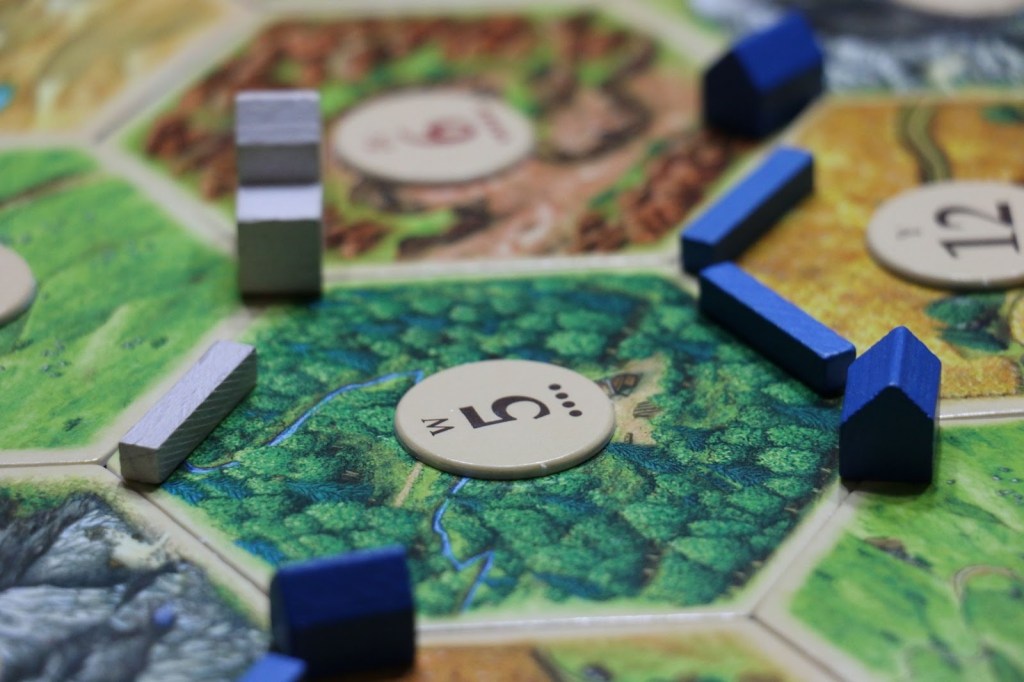
Games invite deeper analysis, and substantial research already exists into the different kinds of political and social narratives embedded in popular video games. But board games are an analog format in which narratives are both emergent through the mechanics of play as well as embedded into the game narrative and aesthetics by the designers. Take Settlers of Catan (1995), a beloved German family game from the 1990s. While the game may at first appear more harmonious than the ruthless landlordism of a game like Monopoly (1935) (ironically, a game originally designed as a critique of Capitalism), Catan is ultimately a game about settler colonial expansion. The island of Catan is imagined as an uninhabited, resource-rich frontier, available for extraction, trade, and development. To win the game, players have to expand settlements and roads across the island as quickly and efficiently as possible. Sharing space is out of the question, and play becomes a scramble for territory.
Other games are even less subtle about the attached narratives – Puerto Rico (2002), another ‘Eurogame’ classic (ranked #54 in the top 100 board games of all time), is a game about managing a colonial plantation. From the game’s description – “The resource cycle of the game is that players grow crops which they exchange for points or doubloons… Buildings and plantations do not work unless they are manned by colonists.” Within this mechanical abstraction, the historical realities of forced labour are implicit, but hidden. The system requires a labouring population to keep plantations productive, yet the enslaved peoples upon whom the colonial economy depends are rendered invisible within the narrative framing and the gameplay loop. Games as a medium offer more than just thematic framing; the mechanics of the games themselves dictate how players must think and interact if they are to win, and the logic of expansion, extraction and competition runs through the vast majority of modern board games, with even ‘peaceful’ games like Ticket to Ride (2004) demanding cutthroat adversarialism and competition in building a rail empire. Board games frequently centre on resource management, land acquisition, wealth accumulation, and competitive victory, and are typically founded on the assumption that play must culminate in a single winner.
“Are the logics of extraction, expansion, exploitation and competition simply baked into the format?”
More recently, a significant number of contemporary board games have begun to adopt ostensibly “neutral” themes. Players arrange mosaic tiles or stained-glass patterns in Azul (2017) and Sagrada (2017), or cultivate habitats and observe wildlife in Wingspan (2019) and Cascadia (2021). Yet even these comparatively tranquil settings remain structurally instrumental. The thematic elements (whether wildlife, ecosystems, or artistic production) are operationalised as resources within a competitive framework. Animals and habitats function as point-generating assets, and artistic creation is reframed as a zero-sum contest. In this way, both the subject matter and the presence of other players are subsumed under a logic of strategic maximisation: the former becomes a means to victory, and the latter obstacles to be managed. Even within ‘softer’ themes, it would appear that the very format of what we understand as a modern board game demands a specific form of encounter: the environment is construed as a field of extractable value, and other players are positioned as rivals within a scarcity-driven system. This raises the question: Are the logics of extraction, expansion, exploitation and competition simply baked into the format?
This is before we even consider the very large number of games explicitly about war. Among the highest-ranked board games of all time are numerous war games that are thematically reskinned through major popular franchises, including Star Wars, The Lord of the Rings, and Dune. In these cases, established properties provide a familiar narrative and aesthetic framework, but the underlying mechanical structure remains centred on territorial control, military conflict, and strategic domination. Variations on the types of warfare that can be gamified also exist. For example, Root (2018) situates players in a forest battleground of asymmetrical warfare between cats, birds, and woodland creatures. While the game’s unique design is celebrated, with each player aiming for different objectives such as insurgent rebellion or pure expansion, the fundamental narrative framing and mechanical structures of the game demand combat, confrontation, and conflict.
“If games can be used to simulate and understand conflict dynamics, why can’t they do the same for peace?“
Risk (1956) is a classic game of global domination, in which players use conquest, conflict and diplomacy to wipe out their rivals. But the pieces on the board could be anything from bacteria competing for space inside the gut of a sheep to simply abstract shapes without specific meaning, as in Checkers or Backgammon – and yet, the design of Risk is explicitly framed as being about armed conflict. Likewise, Chess (600 CE) – one of the oldest games that can still be considered a ‘board game’ – is a scale model of war, with political, military and even religious units fighting for a binary dominance of the board. Yet the ubiquity and timelessness of Chess obscures the way in which what is essentially a formal, mathematical, strategic puzzle has been narrativised as a war game.
We must therefore ask ourselves why war as a narrative seems to map so neatly onto gameplay. At the same time, we can interrogate the reverse – why do games map so neatly onto war? Game Theory is a small but significant sub-field of International Relations, and while it does not concern itself with tabletop board games, it does use gamification and ‘game logics’ (zero-sum games, symmetry, discrete games, etc.) to simulate, theorise and even justify real-life military theory. The Prisoner’s Dilemma, one of game theory’s most famous thought experiments, uses a game-like setup of realist zero-sum logic to simulate how actors interact when given the option to co-operate with or betray other actors, and how those actors then respond to your actions – and so forth. We should, of course, remind ourselves that war is not a game, and should not be trivialised or treated simply as an intellectual exercise. But if games not only portray narratives of war, but can also be used to simulate and understand conflict dynamics, then why can’t they be used to simulate and understand peace dynamics?
Games also have a huge potential for social and educational applications. Peace Education is a way of teaching skills, knowledge and values to people in an effort to reduce violence and promote justice and peace. While this education can take many forms, games have been used as an experimental form of Peace Education, inviting players to learn and reflect on conflicts and violence. The problem is, there simply aren’t many board games about Peace. Considerable new research exists into designing interactive video games simulating peace processes and conflict resolution activities, and there have even been projects exploring the social effects of bringing people from different sides of a conflict together to play creative and non-competitive games such as Minecraft. But similar efforts in the world of analog games have yet to emerge.
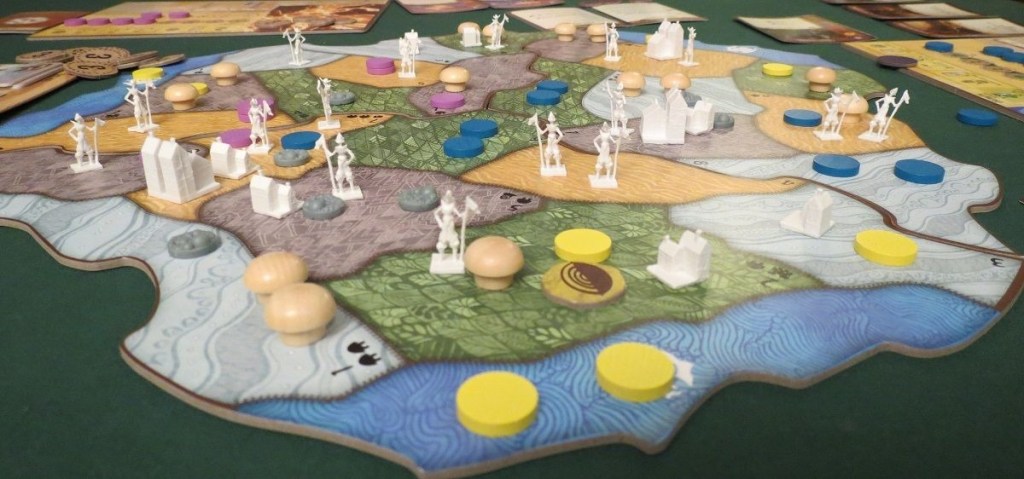
What about co-operative games? Indeed, there is a growing category of games designed to be played by multiple people working together. But there are glaring conceptual issues with understanding these as ‘peace games’, too. Pandemic (2008), one of the most popular co-operative games of all time, is all about preventing the spread of a deadly virus around the world. All players are working to stop the virus and find the cure before humanity is doomed. But this format has co-operation coded into the setup from the beginning, and, since the game assumes that everyone has the same set of goals and priorities, and is equally willing to contribute individual resources for a collective goal, we can argue there is no real peace at work when players are given no choice but to co-operate. Similarly, Spirit Island (2017), a more recent game with an anti-colonial theme (described by the box art as a ‘settler-destruction strategy game’), has players working together as elemental spirits to fight back against an invasion of settlers who poison the land with blight. While a clever inversion of the scenario of Catan, the indigenous islanders are still given no voice or agency, and are used as literal pawns to fight back against the European colonisers. As refreshing as the theme is, the logic of conflict is still at work here, and the structure of the game presumes that the interests of the players and the non-playable indigenous people are all aligned, without representing or exploring any of the interests of subjugated peoples deeper than a superficial subsumption into a category of ‘nature fighting back’.
Some games are a thematic far cry from any political or international relevance, but are mechanically closer to how a peace game might look. Décorum (2022) is a game about two or more people living together, each with their own specific tastes in interior design. The problem is communication, as you can only tell other players whether you like or dislike the current layout, but not what your specific tastes or needs are. Together, you must figure out how to decorate the house in such a way that everybody’s tastes are satisfied. This is a fun co-operative puzzle, and while each player has individual goals, the victory is collective. What’s more, the potential for adapting the game design and replacing furniture with peace negotiations is immediately obvious. But this approach still assumes that there is a correct ‘solution’ to the issue that everybody can be happy with, and presupposes that all parties will be satisfied with a collective rather than individual victory. Games such as these help to underline the critical and problem-solving potentials of co-operative experience, but appear to remain bound by certain structural limits of the format.
With all of this in mind, if games structurally demand competition, and war can be seamlessly ‘gamified’, then what about peace? Are we able to flip these logics around and design a game around co-operation and non-zero sum outcomes? What would that look like? Could it be used as an educational tool? And, perhaps most importantly, would it be fun? It was with all of these questions in mind that I designed the ‘Playing Peace’ Workshop in December 2025. Drawing on Game Theory, Peace Education, Ludology, Critical Analysis and my own personal interest in board games, the aim of the workshop was to explore ideas of Peace through board games. We invited two guest speakers from very different contexts to share their insights.
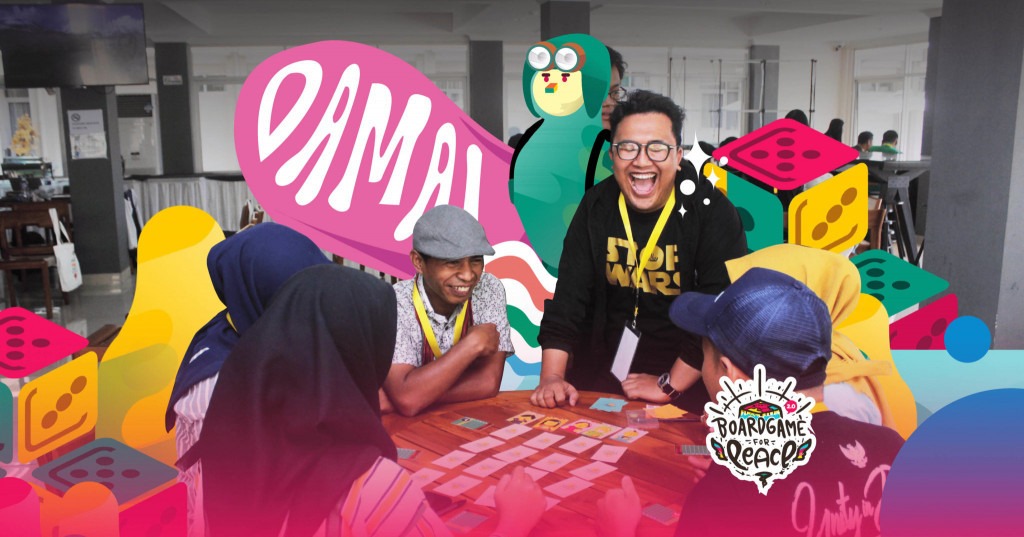
The first guest speaker was Jeremiah Bonifasius Manurung, a learning officer at Peace Generation (PeaceGen) Indonesia. PeaceGen had previously delivered workshops on designing and playing board games in their peace education efforts in Indonesia, and Jeremiah shared with us the principles and outcomes of their projects. “The Indonesian context”, he clarified, “is characterised by a number of ethnic and religious tensions. Our work aims to educate young people about peace but also to help bring down these barriers between groups.” It was encouraging to hear that board games could be used as an effective way of helping young people to engage with critical thinking, peace values, and co-operative problem solving. The outcomes were clear – participants left the PeaceGen workshops with new attitudes and understandings of peace.
The second guest speaker was Sami Laakso, a board game designer from Finland. His game, Peacemakers (2024), puts players in the middle of an active conflict between two warring animal species. Using a mixture of sabotage, diplomacy, and manipulation, players must bring the motivation of both sides down to the point where neither side surrenders entirely, but neither wants to continue the conflict. Aiming for this ‘sweet spot’ is not only an interesting game mechanic, but is also reflected in conflict management’s ‘Ripeness Theory’ – the idea that a conflict needs to reach a point at which a ‘mutually hurting stalemate’ encourages both sides to end the conflict. However, in the game, as in real-life conflicts, this approach treats conflict as something that can be ‘solved’ with the correct series of actions – up to and including further violence. As Grace Orao, an experienced peace educator herself, rightfully pointed out during our playthrough, “this is not really a Peace game at all.” Indeed, the game is more of a peace-based approach to a war game than a peace game. By dictating the win condition, the game also dictates a limited vision of what peace looks like and how we can get there. Nevertheless, ‘Peacemakers’ is a fun experience and a fresh take on war games, in which players are not fighting for either side of a war, but rather try to end the conflict entirely. Sami gave us valuable insight into his design process, his philosophy of avoiding conflicts, and the general challenges that accompany creating a board game from scratch.
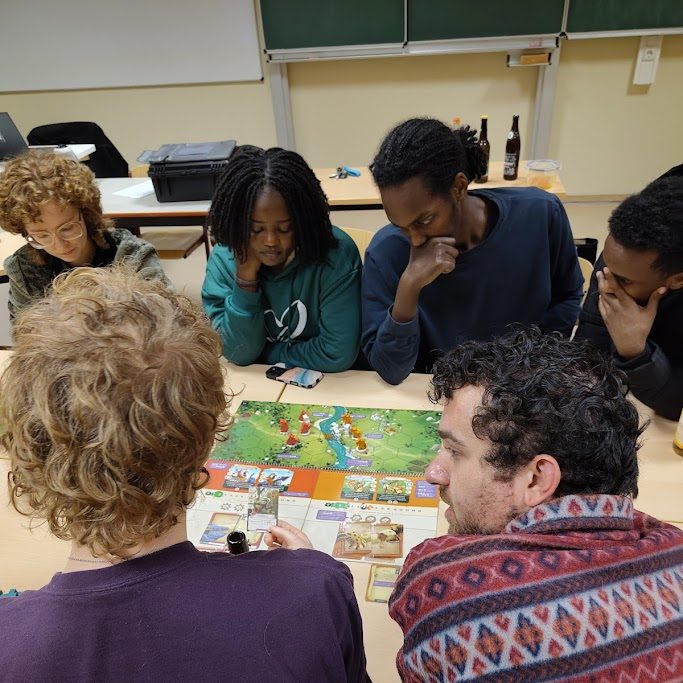
The workshop generated lively discussion, prompting students to critically examine the intersections between game design, war narratives, and the dynamics of play. One unresolved question that emerged was “Can peace be competitive?” Peace is a complicated and contested concept, so designing a peace game is a considerable design challenge. Aside from the inherent challenges associated with making a game simultaneously coherent, challenging, accessible, and fun, a peace game may also have to subvert some of the fundamentals of the format as a whole. Victory could be both collective and individual, providing players with legitimate reasons to both cooperate with and betray each other, thereby creating opportunities to achieve meaningful peace. But if the designers prescribe what a peaceful victory looks like, they are also deciding what peace looks like. Perhaps, then, the most radical approach is to allow players themselves to determine when peace has been achieved. If a peace game is to be used as a social or pedagogical tool, then such an approach has clear value. But within the constraints of the established market of modern board games, such an experience might be unrecognisable as a board game at all. Ultimately, the challenge of designing a peace game may not be a structural limit of the format itself, but rather a limit of the imagination of the people who design them. Maybe a truly novel and ‘peaceful’ form of gaming is possible, and the format can be pushed in critical new directions. Or maybe, as anyone who has ever played a board game with close family has surely learned, the most peaceful strategy may simply be not to play at all.
Further Reading:
Flanagan, M. (2009). Critical play: Radical game design. The MIT Press.
Woods, S. (2012). Eurogames: The design, culture and play of modern European board games. McFarland & Company.
 pax
pax 
Leave a comment